Bom Jesus do Monte, explained
Most of the confusion about this place goes away once you accept that the stairway is not the route to the church. It is the point of the church. The chapels, the zigzags, the fountains with water coming out of their eyes: all of it is meant to be walked through in one order, and it took more than six hundred years to build that way.
What a sacred mount is
After the Council of Trent, the Catholic church in southern Europe took to building artificial pilgrimage hills: a wooded slope, a stepped path, chapels along it, a church at the summit. A person who could not get to Jerusalem could walk a scale model of it at home. UNESCO uses that language about Braga, calling the hillside a cultural landscape that evokes Christian Jerusalem, and inscribed it in 2019 under criterion (iv) — 26 hectares of property inside a 232-hectare buffer zone, listed as a landscape and not as a building. The confraternity that owns it, the Confraria do Bom Jesus do Monte, dates from 1629: the brotherhood, not the church you can see, so the sanctuary itself is younger than 1629.
Why the stairway is shaped the way it is
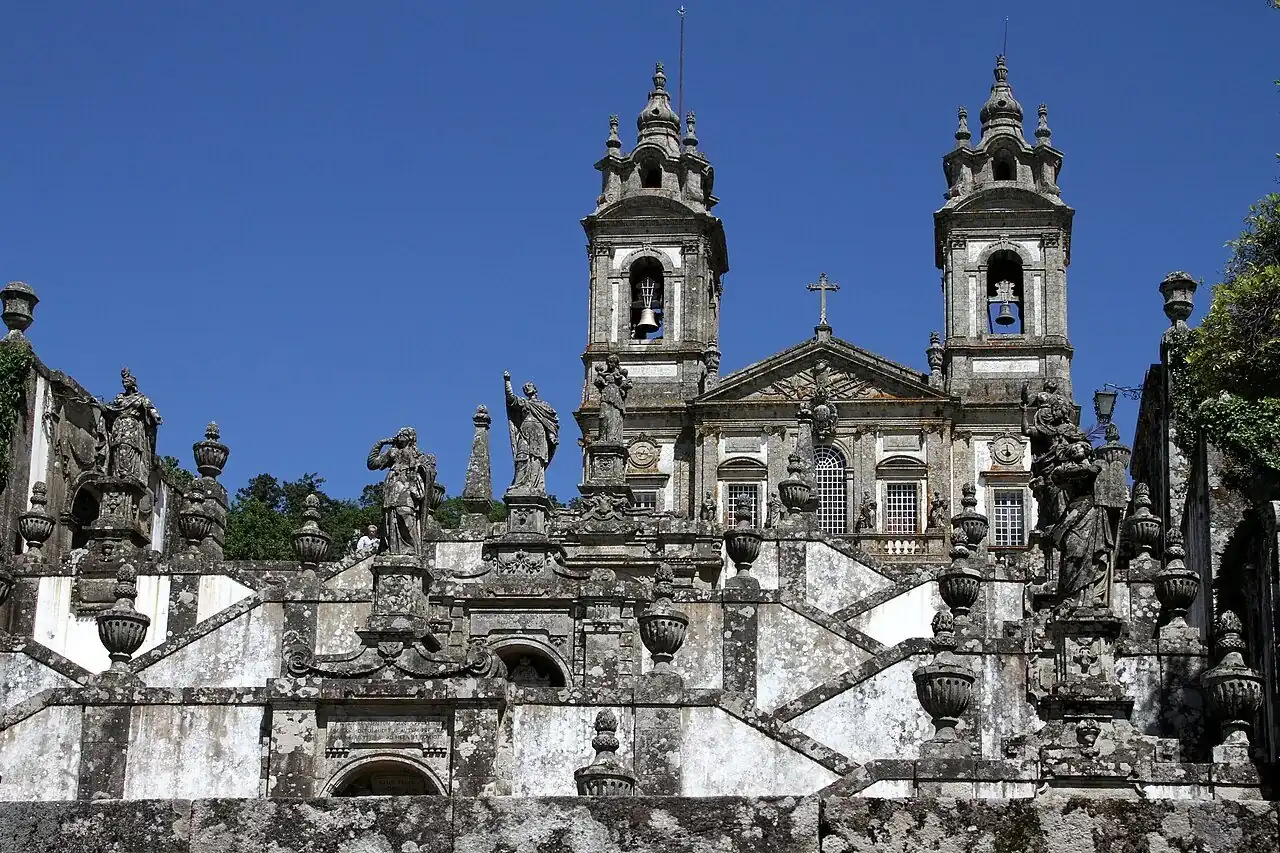
From the portico at the bottom to the churchyard at the top is 573 steps and a climb of 116 metres, according to the Confraria’s own site, which breaks it down as 376, then 104, then 93. Those add to 573 exactly. English Wikipedia says 583: the official page separately counts a further 34 stairs below the churchyard, so where you start and stop counting moves the total. I have walked it several hundred times and never got the same number twice. Both counts are on the stairway page.
The three flights do different jobs. The first is the Via Sacra, lined with chapels of terracotta Passion scenes; eight primitive chapels were traced along it in the 1700s and only the first two survive. The second is the Escadório dos Cinco Sentidos, the zigzag one everybody photographs, with a fountain at each turn for Sight, Smell, Hearing, Touch and Taste. The water leaves the sculptures through the eyes, the nose, the ears and the mouth, which is cruder and better than it sounds in front of it. The third, the Escadório das Três Virtudes, was added around 1781 for Faith, Hope and Charity. Armillary spheres run along the parapets the whole way up.
The argument you walk up
Read in order, the climb is a piece of reasoning. You start among images of the Passion, you pass the five bodily senses on the zigzags, and only then reach the three theological virtues on the last flight. Senses low down, virtues high up. You make the argument with your legs, and it explains the zigzags: a straight staircase would have been quicker and would have wrecked the sequence, because the turns are what stop you at each fountain.
At the top is the basilica, the Neoclassical church by Carlos Amarante, built 1784–1811 and consecrated in 1834. Both dates are right: one is the building work, the other the consecration. It replaced a Baroque church of about 1725 by Manuel Pinto Vilalobos. Behind it the ground flattens into park, with a lake and rowing boats that almost nobody on a day trip ever sees.
The funicular, as a piece of engineering
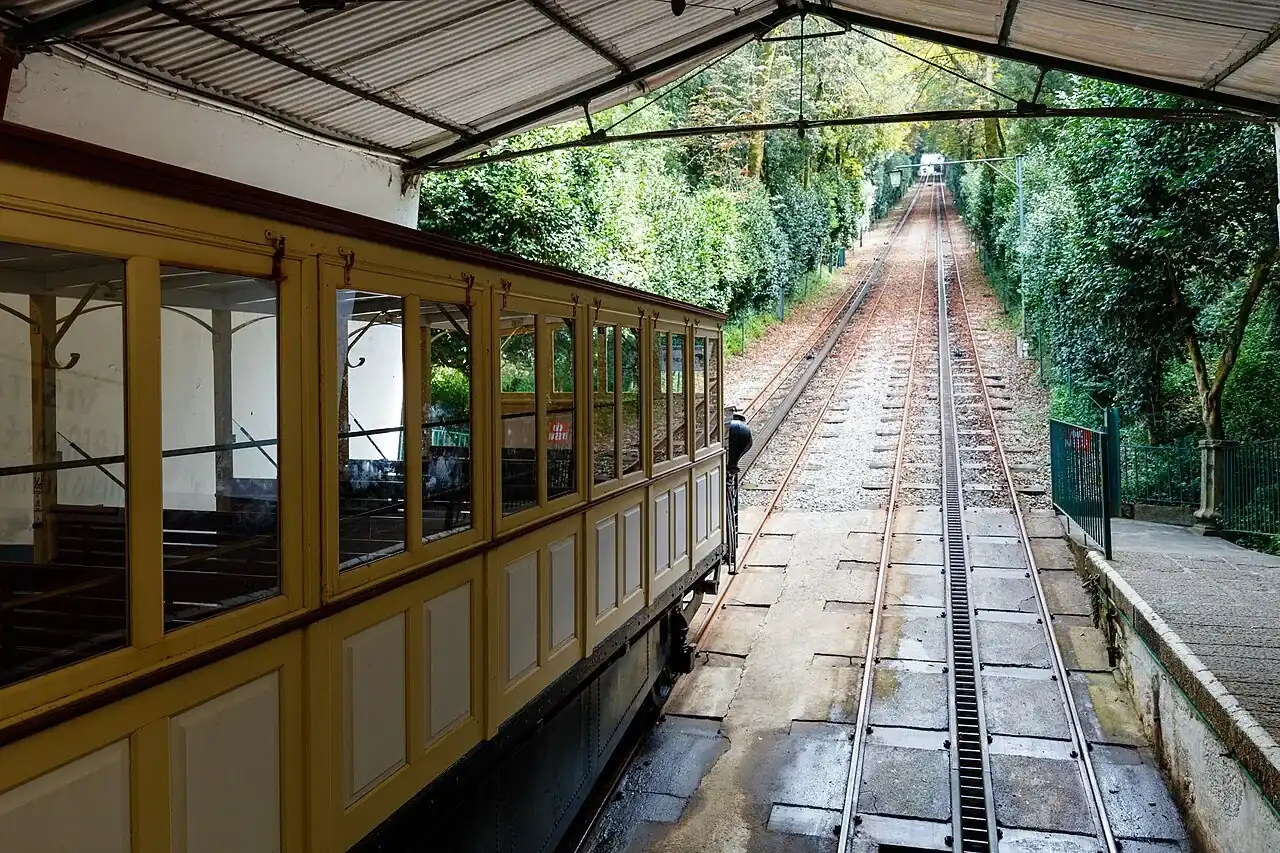
Work started in March 1880 and the Elevador do Bom Jesus opened on 25 March 1882. The Swiss engineer Nikolaus Riggenbach designed the project and sent the instructions from Switzerland; Raul Mesnier du Ponsard superintended the works on the ground. This follows the Confraria’s own page and Portuguese Wikipedia.
It runs 274 metres of standard-gauge track, 1,435 mm, and climbs the same 116 metres the stairway does. That is a gradient of 42 percent — per cent, not degrees, because 116 divided by 274 is 42.3. Two cars are counterbalanced by water: the main tank holds 5,850 litres, a second tank of 216 litres feeds the rear brakes. Fill the top car, empty the bottom one, gravity does the rest. Each car seats 30 on six benches of five and takes up to 8 standing plus the conductor, and the trip lasts two and a half to four minutes depending on the load. It was the first funicular built in the Iberian Peninsula and is the oldest in service anywhere using water counterbalance. The fare is a couple of euros, paid at the bottom; the last published figure and its source are on what it costs, and the machine itself on the funicular page.
What a guide adds when the site is free
Visiting Bom Jesus do Monte is free. The grounds are open around the clock, the basilica charges nothing, and a bus from central Braga reaches the bottom gate in about half an hour.
Money buys three things here. Transport, the real expense if you are staying in Porto 42 km away. Someone who can tell you which chapel is which and why the nose is dripping. And, on exactly one of the tours listed here, the funicular ticket. Entry is free, so check each listing for what its price covers (the tickets page). Choosing between a day trip and a train is done on the Porto page, and if you are minded to add Guimarães to the same day, read one day or two first — the people who wished they had longer here all gave their tour five stars.
Frequently asked questions
Do I need to read this before I go?
Not at all. The sanctuary is free and open around the clock, and the stairway was built to be read, so a little background adds a lot. If you only have one minute, read the section on the Five Senses and look at the fountains on the way up.
Is the stairway 573 steps or 583?
The Confraria that runs the sanctuary counts 573 from the portico to the churchyard, and publishes the three flights that make it up — 376, then 104, then 93. Wikipedia says 583. The same official page also counts 34 more steps below the churchyard, so where you start and stop moves the total. I use 573 because it is the operator’s own figure and its parts add up. More on that on the stairway page.
Who actually built the funicular?
The Swiss engineer Nikolaus Riggenbach designed it and sent the instructions from Switzerland; Raul Mesnier du Ponsard superintended the works in Braga. This follows the Confraria’s own site and the Portuguese Wikipedia article. It opened on 25 March 1882. See the funicular page.