The history of Bom Jesus do Monte
A sacred mount, not a church with steps
Bom Jesus belongs to a European idea rather than a Portuguese one. After the Council of Trent the Church promoted sacred mounts: hillsides laid out as a devotional route, with chapels staged along a climb so that the walk itself does the teaching. UNESCO describes this one as a cultural landscape that evokes Christian Jerusalem, a sacred mount crowned with a church. Once you know that, the stairway stops looking like an unusually elaborate way to reach a door.
The confraternity that runs the place was founded in 1629, and it still runs it. That date belongs to the brotherhood, not to the buildings: nothing you can see from the road is that old, and the church you walk into is from the turn of the nineteenth century.
The eighteenth century, which is when most of it happened
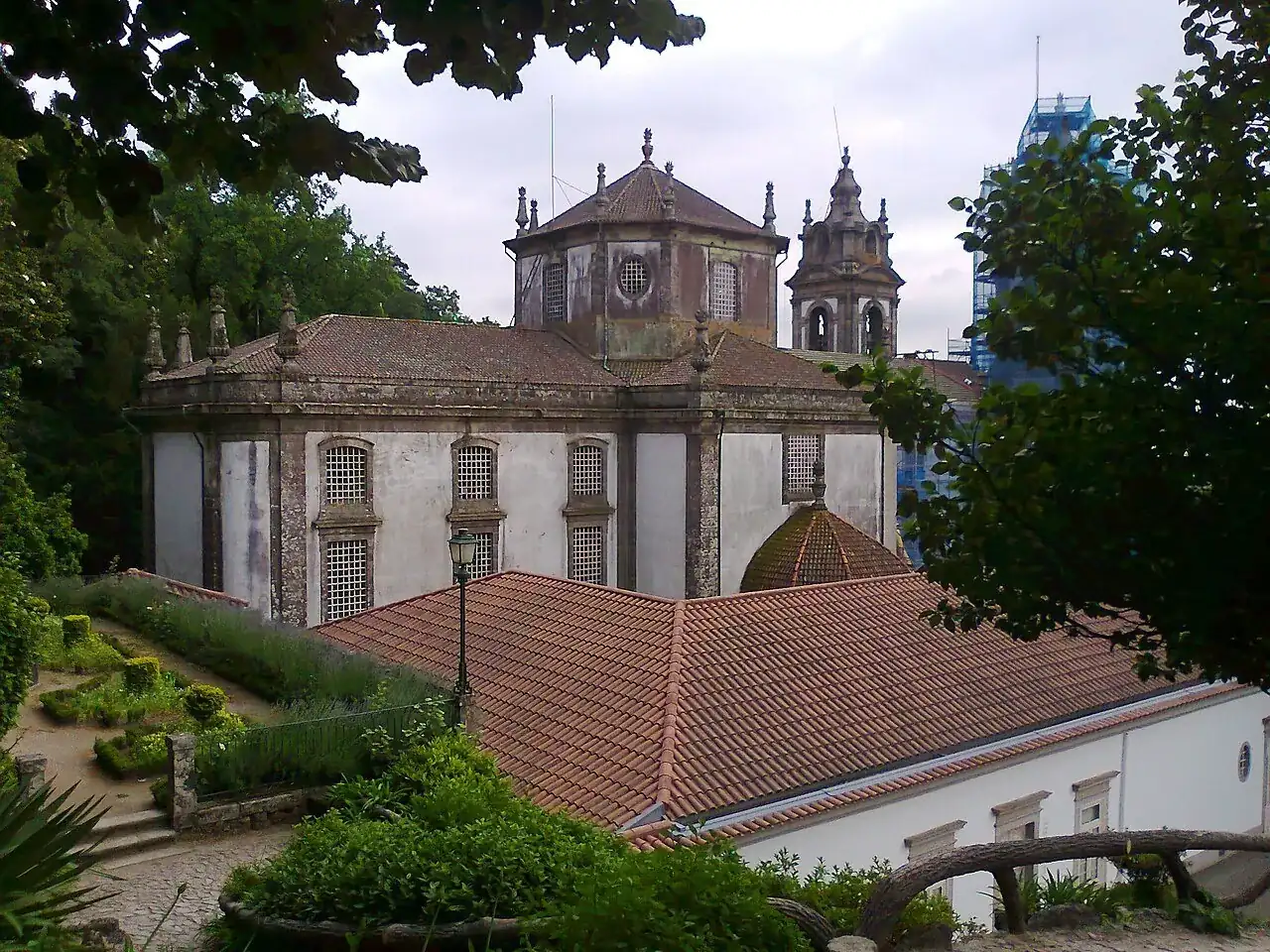
The Via Sacra was traced in the 1700s with eight primitive chapels, of which the first two survive; the rest of what you pass came later. The zigzag Escadório dos Cinco Sentidos and its fountains belong to the same great Baroque push, and the Escadório das Três Virtudes was added around 1781. An earlier Baroque church of about 1725, attributed to Manuel Pinto Vilalobos, stood at the top while all this went on.
Then taste changed. Carlos Amarante replaced the Baroque church with a Neoclassical one built between 1784 and 1811, its interior finished over the following decades, and it was consecrated in 1834. The two dates get quoted against each other as if one were wrong. They are not in conflict: the first is the build, the second is the consecration.
1882: the hill gets a railway
By the late nineteenth century the sanctuary was drawing crowds that had to walk up, so the confraternity commissioned a funicular. Work began in March 1880 and it opened on 25 March 1882, the first funicular built in the Iberian Peninsula, counterbalanced by water and still running that way. It is the oldest water-counterbalanced funicular still in service anywhere, and the engineering is worth a page of its own, which it has: the funicular.
2019: UNESCO
The Sanctuary of Bom Jesus do Monte was inscribed on the World Heritage List on 7 July 2019 under criterion (iv), covering 26 hectares with a buffer zone of 232 hectares. The citation is about the landscape as a whole, the sacri monti tradition and the way the Baroque stairway stages a Christian Jerusalem on a hillside above Braga, rather than about any single building on it.
If you read one thing before you climb, read the order of the fountains. The senses come before the virtues on purpose: you clean up the body, then the soul, and only then do you get to the church.
What survives, and what to look for
Six centuries of building means the site is a sequence of periods stacked on one hillside, and the seams are visible if you know where to look. I have set out the individual features on the what-to-see page, the counting question on the stairway page, and the whole argument at length in the complete guide. None of it costs anything to visit, which surprises people often enough that it needs its own page.
 Deep dive
The Soul of Braga: Cathedrals, Palaces and Sanctuaries
 Sanctuary only
Historical Trail of Bom Jesus do Monte
 Small group
Braga & Guimarães Tour: Small-Group Historical Tour
Frequently asked questions
How old is Bom Jesus do Monte?
The confraternity dates from 1629 and the site developed over more than six hundred years, but the buildings are younger than that: the great stairway is eighteenth-century, the basilica was built between 1784 and 1811 and consecrated in 1834, and the funicular opened in 1882.
Why was the stairway built like that?
It follows the sacred-mount tradition promoted after the Council of Trent, in which a hillside is staged as a devotional route. The chapels, then the five senses, then the three virtues form a sequence you climb through, which UNESCO describes as evoking Christian Jerusalem.
When did Bom Jesus do Monte become a UNESCO site?
It was inscribed on 7 July 2019 under criterion (iv), with a listed property of 26 hectares and a 232-hectare buffer zone. The inscription covers the cultural landscape rather than a single monument.
Who designed the basilica at Bom Jesus?
Carlos Amarante designed the present Neoclassical church, built 1784 to 1811. The earlier Baroque church on the site, from around 1725, is attributed to Manuel Pinto Vilalobos. What you can see of each is covered on the what-to-see page.