The Bom Jesus funicular: 1882, and still counterbalanced by water
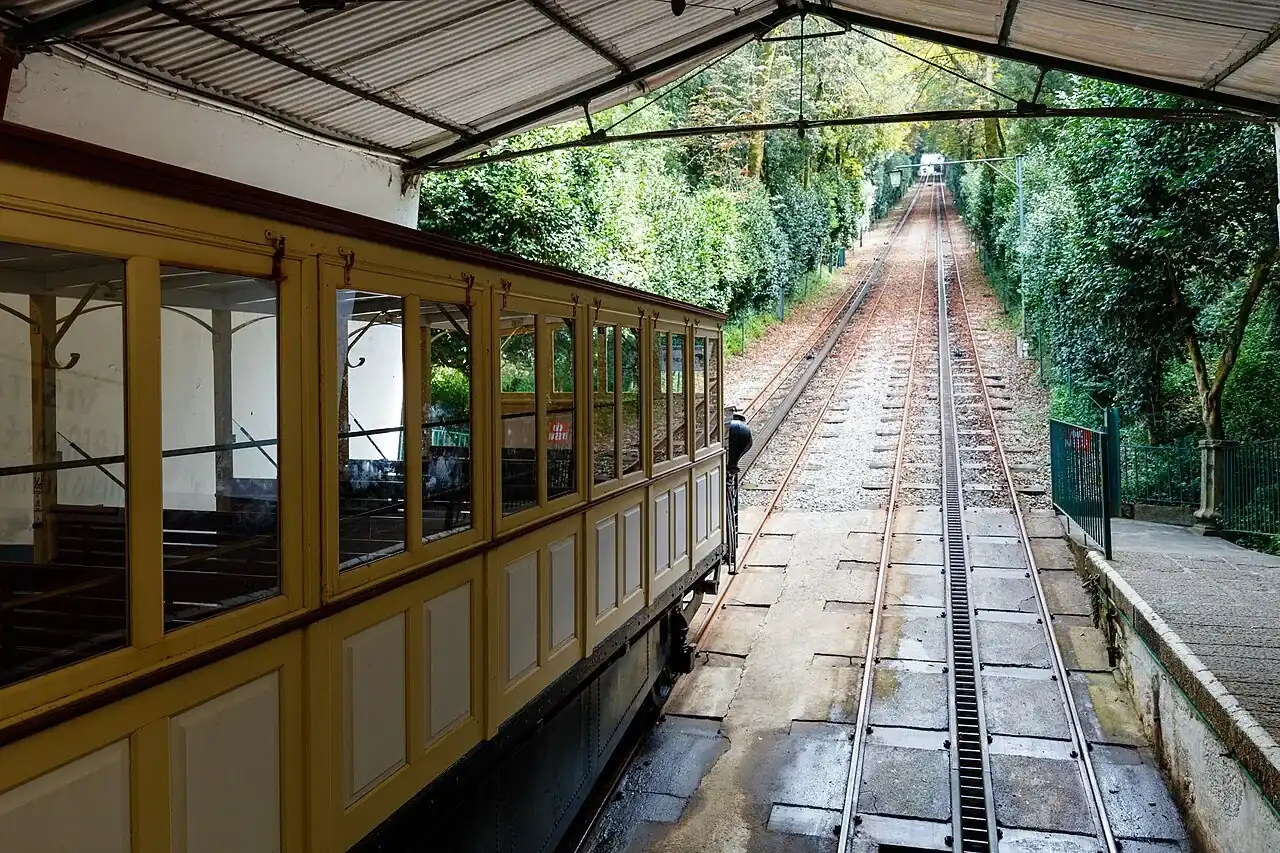
How it works
There is no engine. Each car carries a tank under the floor holding 5,850 litres, plus a second tank of 216 litres that feeds the rear brakes. The conductor at the top takes on water until his car outweighs the one waiting below, releases the brakes, and the heavy car descends while the light one is drawn up. At the bottom the water is dumped and pumped back up the hill. Two cars run on parallel tracks with a central rack rail between them, standard 1,435 mm gauge, thirty seated on six benches of five with room for another eight standing and the conductor.
It is a system with very few moving parts and no fuel, which is largely why it is still here. The Confraria calls it the first funicular built in the Iberian Peninsula, and the defensible superlative is that it is the oldest still in service anywhere that works by water counterbalance.
Who built it, and who gets the credit
Work began in March 1880 and the line opened two years later. The project was designed by the Swiss engineer Nikolaus Riggenbach, who sent the instructions from Switzerland, and Raul Mesnier du Ponsard superintended the works on site.
This follows the Confraria’s own site and the Portuguese Wikipedia article. Riggenbach is also the man the rack system is named after, which makes the attribution above the less surprising of the two.
The gradient is 42 percent, not 42 degrees
The line rises 116 m over 274 m of track. Divide one by the other and you get 0.423, so the gradient is 42.3 percent, which as an angle is about 23 degrees.
While we are counting: the track is 274 m in both Wikipedias, while the Confraria’s English page says 267 m. I use 274 m, and mention 267 m so you know the difference exists.
Riding it or climbing it
What works
- It climbs the same 116 m as the stairway without you doing any of the work
- The ride is short, so you are not choosing between it and your morning
- It runs often enough that turning up and waiting is a reasonable plan
- It is the sensible way up if stairs are a problem — see the accessibility page
Worth knowing
- You miss the chapels and the fountains, which are the point of the climb
- Hours are seasonal and two sources give different ones, so check before you plan around it
- The fare is cash-friendly and small, but it is not free the way the site is
- It closes for maintenance, and when it does the 573 steps are the only way up
What I usually suggest: walk up, ride down. The stairway is designed to be climbed in one direction, the fountains read in order from the bottom, and coming down 573 steps is harder on the knees than going up them. If you would rather ride both ways, the fare is on the cost page .
Exactly 1 of the 22 guided tours includes the funicular ticket, the small-group walking tour from €59 per person. On the others you buy your own at the booth. There is more on what is and is not chargeable here on the tickets page.
Frequently asked questions
When was the Bom Jesus funicular built?
Construction began in March 1880 and the funicular was inaugurated on 25 March 1882. It has been in service ever since, which makes it the oldest working funicular anywhere that uses water counterbalance, and the first one built in the Iberian Peninsula.
How does the water-powered funicular work?
The upper car fills a 5,850-litre tank until it is heavier than the lower car, and the cable between them does the rest: the heavy car sinks, the light car rises. At the bottom the water is emptied and pumped back uphill. A second 216-litre tank feeds the rear brakes.
How steep is the Bom Jesus funicular?
42 percent. It climbs 116 m over 274 m of track, and 116 divided by 274 is 0.423. You will sometimes see 42 degrees quoted, which would be roughly twice as steep; the real angle is about 23 degrees.
Is it worth taking the funicular instead of the stairs?
If stairs are difficult, it is the answer, and it is the only way up other than the road. If they are not, walk up and ride down: the fountains and chapels of the 573-step climb are laid out to be read from the bottom, and they make no sense in reverse.